- Deliverability
-
Safe
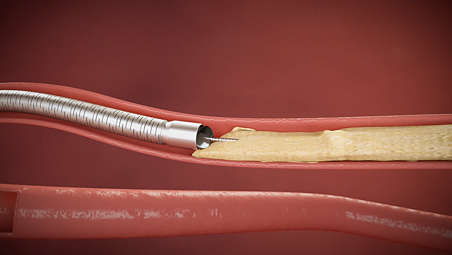
The front cutter clears tissue in a way that may help reduce potential trauma to the vessel, demonstrating a 1.9% perforation rate and a 0.9% dissection rate. [3]† The design of the Phoenix cutter head allows debulked material to be continuously captured, showing a <1% distal embolization rate and 0% use of distal protection. [3] ‡ - Front cutter
-
Simple*
Phoenix is designed for single insertion, featuring a low-profile front cutting element at the distal tip for direct lesion access. Material is shaved and continuously captured within the catheter and cleared via an Archimedes screw. This cut, capture, and clear mechanism eliminates the need to remove the device during the procedure.* The system is powered by a motorized handle, requiring no capital equipment or additional procedural accessories. - Versatility
-
Effective [2]
Data from the EASE trial confirms Phoenix’s ability to effectively treat a broad range of tissue types, from soft plaque to calcified arteries, for lesions both above and below the knee. The effectiveness endpoint set in the EASE trial was exceeded, and a<1% clinically driven target lesion revascularization (TLR) was achieved through 30 days. [3] - Ease of use
-
Proven success [3-9]
Across seven studies and over 1,000 patients, Phoenix demonstrated a procedural success rate of 90-100% with no filter device and a <1% symptomatic distal embolization. [3-9]
Safe
Safe
Safe
Simple*

Simple*
Simple*
Effective [2]
![Effective [2]](https://images.philips.com/is/image/philipsconsumer/4b0bb6604cbd49028cc9b46500e59756?wid=452&hei=255&$jpglarge$&fit=crop)
Effective [2]
Effective [2]
Proven success [3-9]
![Proven success [3-9]](https://images.philips.com/is/image/philipsconsumer/8f56575b01c44305a197b48d00fd7ff8?wid=452&hei=255&$jpglarge$&fit=crop)
Proven success [3-9]
Proven success [3-9]
- Deliverability
- Front cutter
- Versatility
- Ease of use
- Deliverability
-
Safe
The front cutter clears tissue in a way that may help reduce potential trauma to the vessel, demonstrating a 1.9% perforation rate and a 0.9% dissection rate. [3]† The design of the Phoenix cutter head allows debulked material to be continuously captured, showing a <1% distal embolization rate and 0% use of distal protection. [3] ‡ - Front cutter
-
Simple*
Phoenix is designed for single insertion, featuring a low-profile front cutting element at the distal tip for direct lesion access. Material is shaved and continuously captured within the catheter and cleared via an Archimedes screw. This cut, capture, and clear mechanism eliminates the need to remove the device during the procedure.* The system is powered by a motorized handle, requiring no capital equipment or additional procedural accessories. - Versatility
-
Effective [2]
Data from the EASE trial confirms Phoenix’s ability to effectively treat a broad range of tissue types, from soft plaque to calcified arteries, for lesions both above and below the knee. The effectiveness endpoint set in the EASE trial was exceeded, and a<1% clinically driven target lesion revascularization (TLR) was achieved through 30 days. [3] - Ease of use
-
Proven success [3-9]
Across seven studies and over 1,000 patients, Phoenix demonstrated a procedural success rate of 90-100% with no filter device and a <1% symptomatic distal embolization. [3-9]
Safe
Safe
Safe
Simple*
Simple*
Simple*
Effective [2]
Effective [2]
Effective [2]
Proven success [3-9]
Proven success [3-9]
Proven success [3-9]
Specifications
- 1.8mm x 130cm tracking catheter
-
1.8mm x 130cm tracking catheter Part Number - P18130K
Introducer size - 5F (greater than 1.8 mm)
Working length - 130 cm
Guidewire diameter - 0.014”
-
- 1.8mm x 149cm tracking catheter
-
1.8mm x 149cm tracking catheter Part Number - P18149K
Introducer size - 5F (greater than 1.8 mm)
Working length - 149 cm
Guidewire diameter - 0.014”
-
- 2.2mm x 130cm tracking catheter
-
2.2mm x 130cm tracking catheter Part Number - P22130K
Introducer size - 6F (greater than 2.2 mm)
Working length - 130 cm
Guidewire diameter - 0.014”
-
- 2.2mm x 149cm tracking catheter
-
2.2mm x 149cm tracking catheter Part Number - P22149K
Introducer size - 6F (greater than 2.2 mm)
Working length - 149 cm
Guidewire diameter - 0.014”
-
- 1.5mm x 149cm tracking catheter
-
1.5mm x 149cm tracking catheter Part Number - P15149K
Working length - 149 cm
Introducer size - 4F (greater than 1.5mm)
Guidewire diameter - 0.014“
-
- 2.2mm x 130cm pre-deflected catheter
-
2.2mm x 130cm pre-deflected catheter Part Number - PD22130K
Working length - 130 cm
Introducer size - 6F (greater than 2.2 mm)
Guidewire diameter - 0.014”
-
- 2.4mm x 130cm pre-deflected catheter
-
2.4mm x 130cm pre-deflected catheter Part Number - PD24130K
Working length - 130 cm
Introducer size - 7F (greater than 2.4 mm)
Guidewire diameter - 0.014”
-
- 1.8mm x 130cm tracking catheter
-
1.8mm x 130cm tracking catheter Part Number - P18130K
Introducer size - 5F (greater than 1.8 mm)
-
- 1.8mm x 149cm tracking catheter
-
1.8mm x 149cm tracking catheter Part Number - P18149K
Introducer size - 5F (greater than 1.8 mm)
-
- 1.8mm x 130cm tracking catheter
-
1.8mm x 130cm tracking catheter Part Number - P18130K
Introducer size - 5F (greater than 1.8 mm)
Working length - 130 cm
Guidewire diameter - 0.014”
-
- 1.8mm x 149cm tracking catheter
-
1.8mm x 149cm tracking catheter Part Number - P18149K
Introducer size - 5F (greater than 1.8 mm)
Working length - 149 cm
Guidewire diameter - 0.014”
-
- 2.2mm x 130cm tracking catheter
-
2.2mm x 130cm tracking catheter Part Number - P22130K
Introducer size - 6F (greater than 2.2 mm)
Working length - 130 cm
Guidewire diameter - 0.014”
-
- 2.2mm x 149cm tracking catheter
-
2.2mm x 149cm tracking catheter Part Number - P22149K
Introducer size - 6F (greater than 2.2 mm)
Working length - 149 cm
Guidewire diameter - 0.014”
-
- 1.5mm x 149cm tracking catheter
-
1.5mm x 149cm tracking catheter Part Number - P15149K
Working length - 149 cm
Introducer size - 4F (greater than 1.5mm)
Guidewire diameter - 0.014“
-
- 2.2mm x 130cm pre-deflected catheter
-
2.2mm x 130cm pre-deflected catheter Part Number - PD22130K
Working length - 130 cm
Introducer size - 6F (greater than 2.2 mm)
Guidewire diameter - 0.014”
-
- 2.4mm x 130cm pre-deflected catheter
-
2.4mm x 130cm pre-deflected catheter Part Number - PD24130K
Working length - 130 cm
Introducer size - 7F (greater than 2.4 mm)
Guidewire diameter - 0.014”
-
Related products
Alternative products
-
Philips Laser System — Nexcimer
- Proven excimer technology
- Versatile: multiple indications across coronary, peripheral and EP service lines
- Simple: turn-key ready in any room
View product
-
Phoenix Guidewire
- Silicone coated, nitinol core
- Supports both tracking and deflecting catheters
- Maintains strength and rigidity for the Phoenix atherectomy system to be directed over the guidewire
- Provides tactile feedback to help with vessel navigation
View product


-
Philips Laser System — Nexcimer
Philips Laser System —Nexcimer— photoablates a wide spectrum of morphologies. Philips laser catheters are indicated in many vessel types and is the only laser system available for lead removal. Powered by a common 100-240V electrical outlet, the system warms up in less than 30 seconds for an easy and fast set-up.
View product
-
Phoenix Guidewire
The Phoenix guidewire is compatible with the Phoenix atherectomy system. It is designed to be simple to use while supporting both tracking and deflecting Phoenix catheters as they gently negotiate the vascular system. It maintains enough strength and rigidity to enable a catheter to be directed over the guidewire with ease, and provides tactile feedback to help with vessel navigation.
View product
- Always read the label and follow the directions for use.
- Philips medical devices should only be used by physicians and teams trained in interventional techniques, including training in the use of this device. Products subject to country availability. Please contact your local sales representative. Philips reserves the right to change product specifications without prior notification.
- Phoenix atherectomy system is distributed by InterMed in New Zealand.
- *The Phoenix Atherectomy 1.5 mm Tracking Catheter is indicated for vessels 2.0 mm in diameter or above. The Phoenix Atherectomy 1.8 mm Tracking Catheter is indicated for vessels 2.5 mm in diameter or above. The Phoenix Atherectomy 2.2 mm Tracking, 2.2 mm Pre-Deflected, and 2.4 mm Pre-deflected Catheters are indicated for vessels 3.0 mm in diameter or above. 1.5 mm, 1.8 mm, and 2.2 mm Tracking Catheters and 2.2 mm Pre-deflected Catheter are indicated for femoral, popliteal, or distal arteries located below the knee. The 2.4 mm Pre-deflected Catheter is indicated for femoral and popliteal arteries only. Refer to product IFU for detailed instructions.
- † Grade C or greater ‡ Requiring intervention
- 1. Rotational atherectomy refers to the Phoenix family of products. 2.4mm deflecting catheter and 2.2 mm auto-deflected catheter have directional cutting ability.
- 2. Schöfthaler C, Troisi N, Torsello G, Jehn A, Lichtenberg M, Karcher JC, Stavroulakis K, D’Oria M, Saratzis A, Zayed H, Andrassy M, Korosoglou G. Safety and effectiveness of the phoenix atherectomy device for endovascular treatment of common femoral and popliteal arteries: Results of the EN-MOBILE trial. Vasc Med. 2024 Mar 17:1358863X241231943. Doi: 10.1177/1358863X241231943. Epub ahead of print. PMID: 38493349.
- 3. Davis, Thomas et al., Safety and effectiveness of the Phoenix Atherectomy System in lower extremity arteries: Early and midterm outcomes from the prospective multicenter EASE study. Vascular. September 27, 2017, DOI: 10.1177/1708538117712383. Target lesion locations: ATK (48%) and BTK (52%). Technical success rate was 95.1% (performance goal was 86%). The 2.2 pre-deflected and the 1.5 tracking catheters were determined to be substantially equivalent to the devices studied in the EASE trial.
- 4. Gandini R, A Single-Center Experience With Phoenix Atherectomy System in Patients With Moderate to ©2021 Heavily Calcified Femoropopliteal Lesions, Cardiovascular Revascularization Medicine 21 (2020), 676–681
- 5. Giusca S, Safety, effectiveness and mid-term follow-up in 136 consecutive patients with moderate to severely calcified lesions undergoing phoenix atherectomy, Heart and Vessels, Oct 2020
- 6. Janas A, Comparison of long-term outcomes after directional versus rotational atherectomy in peripheral artery disease, Adv Interv Cardiol 2020; 16, 1 (59): 76–81
- 7. Giusca S, Hagstotz S, Lichtenberg M, Heinrich U, Eisenbach C, Andrassy M, Korosoglou G. Phoenix atherectomy for patients with peripheral artery disease. EuroIntervention. 2022 Aug 5;18(5):e432-e442. doi: 10.4244/EIJ-D-21-01070. PMID: 35389346.
- 8. Shishehbor et al. Acute Real-World Outcomes From the Phoenix Post-Approval Registry. J Invasive Cardiol. 2022 Jan;34(1):E1-E7. Epub 2021 Dec 19
- 9. Kumarasamy A, Gombert A, Krabbe J, Ruprecht O, Jacobs MJ, Krabbe H. Assessment of Feasibility and Patency of below the Knee Atherectomy Using the 1.5 mm Phoenix Catheter-A Retrospective Study. Medicina (Kaunas). 2022 Nov 3;58(11):1594. doi: 10.3390/medicina58111594. PMID: 36363551; PMCID: PMC9699591.
- 10. Monitor flow of excised material into the disposal reservoir during operation of the Catheter. If flow of excised material ceases during the procedure, this is a sign that the Catheter drive system (cutter, torque shaft, or Handle motor drive) may not be operating properly.
- 11. Case study results are not predictive. Results in other cases may vary.
- 12. Center mass cutting device when the guidewire is centered.
